

Data File Updated: Friday, January 25, 2013
Overview
Faster Than Light travel in Outsider is via "jump drive," which is a form of point-to-point hyperspace travel. A starship activates its jump field generator while on a vector from one star to another, and the ship is propelled into hyperspace, through which it travels (nearly) instantaneously on a ballistic trajectory and re-enters realspace within the gravity well of the destination star. There are no "gates", but the jumping starship must be within the proper outbound zone and have the correct velocity to escape from the originating star and to arrive safely at the destination star.

Optimal jump points tend to be located at significant distance from the system primary, so after jumping, the ship must travel through the normal space of the solar system (using conventional drives) before it can reach the next jump point and jump again to the next star. Jump drive only works between adjacent stars because the gravity wells are needed to govern the "pitch and catch" of the hyperspace transit. Other stars' gravity will interfere with this ballistic hyperspace trajectory, so it's usually not possible to jump "past" a nearby star to a more distant star. This effectively limits safe jump range to roughly 6-10 light years, depending upon the density and mass of stars in the area.
- The energy required for jump is significant, and must usually be built up for several minutes before jump.
- The energy cost to jump is up-front, and the ship is ballistic while in hyperspace. It's like a cannon-shot.
- The energy cost of a hyperspace jump is proportional to the mass of the ship.
- The ship must have some kind of inertial damping system to prevent being torn apart by the transition to hyperspace.
- Both entry into and return from hyperspace cause a bright flash of light that is very detectable at long ranges.
- The jump is nearly instantaneous, so there is not much you can do while in hyperspace.
- Since it is moving faster than light, the ship is blind while in hyperspace.
- Realspace momentum is preserved; you have the same velocity after the jump as you did before you jumped.
- Hyperspace transit has different effects on different species. Many find it unpleasant and disorienting.
- Two masses are required at the start and end points of the jump. You can't jump to or from deep empty space.
- It is generally not possible to do short-range jumps from within the same star system.
- Hyperspace is chaotic and cannot be directly observed, so accuracy of jumps can never be perfect.
- Optimal jump distance (both entry and exit) from a Sun-type star is at about 4-5 AU from the star (Jupiter orbit distance).
- By varying pre-jump velocity and position, a ship can exit shallower or deeper into the target well, but at added risk.
- A hyperspace "miss" usually means that the ship is never seen again.
- The length of a long trip is measured in the time required to travel in normal space from jump point to jump point.
- If a jumping mass returns to normal space where another mass already exists, the result is a high-energy collision.
Jump Mechanics
A jump zone is a conical volume centered on the vector connecting two masses (Fig. I). The outbound jump zone is very wide, and extends some distance out into interstellar space; as long as your initial vector will carry you close enough to the destination star for its gravity well to pull you back out of hyperspace (and as long as you are far enough out / have enough velocity from the departure star to escape its own well), then you don't have to be exactly on the line (the “jump vector”). The inbound jump zone is much narrower; a ship coming out of hyperspace will appear fairly close to this jump vector. How far from the destination star it appears will depend on the ship's hyperspace momentum, which is increased by departure velocity and decreased by jumping from deeper within the departure star’s gravity well.
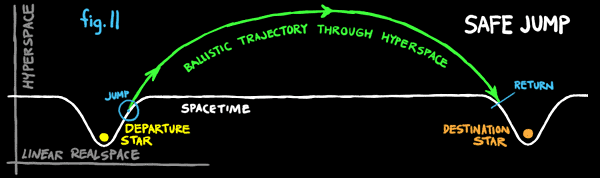
As described in (Fig. II), gravity wells are necessary at the start and end points of the hyperspace jump to achieve proper entry and exit angles into hyperspace. The vessel's starting space-time velocity is added to the +hyperspace momentum provided by the jump drive to give the transiting vessel a ballistic trajectory through hyperspace. Gravity from the stars in realspace still acts on the ship in hyperspace, pulling it laterally between the stars but also "down" in the -hyperspace direction back towards realspace. If the trajectory of the transiting ship again intersects space-time at the proper angle, it will re-embed itself and return to normal space.
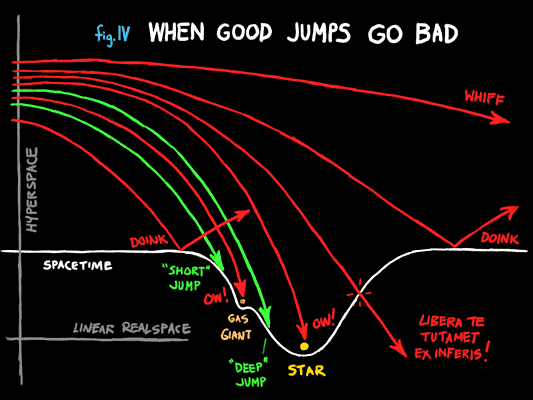
The more hyperspace momentum you have, the "deeper" into the well you travel and the closer you will appear to the arrival star. If you have too much momentum it’s possible to exit hyperspace too close to or even inside the star, or to overshoot it entirely causing a hyperspace “miss.” If you don’t have enough momentum to escape the departure star’s gravity well, you’ll be pulled back in, either exiting hyperspace inside the star or popping out the other side still in hyperspace, again causing a miss. If you intersect space-time at an improper angle, you may bounce off or even punch through to the other side.
 Safety Issues and Failed Jumps
Jumps and exit points can't be calculated with great accuracy, because the exact geometry of the hyperspace-time "curve" you'll be traveling on can't be directly measured. The n-dimensional curvature of hyperspace is chaotic and is affected by many sources, from the gravitation of nearby stars, planets and interstellar gas and dust, to the rotation of the stellar masses and their electromagnetic fields, not all of which you can measure accurately, so there is always an uncertainty factor to account for in your calculations. Therefore, a jumping ship must whenever possible allow for the largest safety margin that it can: it must endeavor to be as close on the vector between the stars as possible, be moving at the optimal escape velocity, and jump at the optimal slope in the departure star's gravity well.
If you jump close on the jump vector, you limit the perturbing influence of your departure star's gravity well to a linear quantity, meaning that it might only affect how deep into the destination star system you arrive. If you jump from a tangential point (Fig. III), then the departure star is pulling you laterally rather than directly back, increasing the chance that you might miss the target altogether. In theory, if your calculations are correct you can jump from a tangent point as illustrated above, but in practice it's extremely dangerous. Maximum arrival distance from the destination varies with the mass of the star, but a successful "short-jump" can often bring you in at the edge of system, outside the orbits of most of the planets. The deeper your jump starts in the departure gravity well, the shallower the exit point is likely to be (Fig. V). Greater starting velocity will also cause the vessel to exit deeper into the destination well.
 |
 |
Hyperspace jumps can be compared to putting a golf ball. In theory, if you hit the ball hard enough on the right trajectory, you should be able to get the ball in the (gravity well) hole from any distance... but in practice, the irregularity of the putting surface makes an accurate putt exponentially more difficult the farther you get away from the hole.
In most cases, the maximum jump distance between stars is about 10 light years, and preferable safe distance is about 6 light years or less. The limitation on jump ranges is based both on limited ability to calculate trajectories past a certain distance (the chaotic element causes the effect of tiny errors to increase geometrically with distance), but also on the interference of nearby stars. The farther you try to jump, the more likely that other stars are going to perturb your trajectory. Higher density of stars will reduce safe jump distance; lower density will increase it.
In a safe jump, the transiting ship reconnects with the space-time curve at the appropriate angle and successfully re-embeds into space-time, usually appearing 4-5 AU from the target star. In a "short jump," the vessel has less than optimal velocity, and so reenters at a more shallow point in the well, and appears farther from the star (often 6-10 AU). Short jumping risks reconnecting with the space-time curve at too steep an angle, causing the vessel to "skip" back into hyperspace. In a "deep jump," the vessel has more than optimal velocity, and so reenters deeper in the well and closer to the star (3 AU or less). Deep jumping risks being pulled directly into the star itself.
 Jumping
vessels that "miss" the target are rarely seen again in this
universe. The various
conditions of a failure on reentry into realspace illustrated in (Fig. IV)
include:
Jumping
vessels that "miss" the target are rarely seen again in this
universe. The various
conditions of a failure on reentry into realspace illustrated in (Fig. IV)
include:
Overshoot. If either the linear realspace velocity is too great, or the +hyperspace momentum is too great, the ship may miss the target well entirely ("whiff"). If the ship has achieved escape velocity in the +hyperspace direction, it may never return to realspace. Otherwise, gravity from realspace will eventually pull it back toward realspace, at which time one of the results below will occur.
Failure to re-embed into realspace because of angle of entry. This can result in the ship rebounding back into hyperspace ("doink"), or in rare cases punching through realspace altogether and being "liberated" into negative hyperspace. The result of a rebound is usually a series of subsequent further skips until the vessel happens along another gravity well, at which point it will have a chance to re-embed, but will most likely do so in an unsafe manner (see: Collision below). Negative hyperspace is an unknown quantity; objects that enter have never returned.
Collision. Objects in realspace do not physically interact with those in hyperspace (except gravitationally), but if the transiting object reenters realspace at the same location as another mass, the result is a high-energy collision. Matter returning from hyperspace does not "materialize," but rather pushes its way through an extra-dimensional portal. Since this entry is very rapid, and the preserved realspace momentum of the transiting ship is usually quite significant, the kinetic energy of any such collision is considerable and usually catastrophic. The most common collision is with the target star itself. Collisions with planets are rare, because inbound jump zones are seldom in the same plane as the planets' orbits, and if it is, then that jump link is probably too dangerous to be used for safe travel. Collisions with smaller objects are very unlikely; the volume of space is very large compared to the size of ships and debris, even in the restricted area of a jump zone.
Hazards Posed by Very Massive Objects
Very massive objects present a hazard to navigation because their mass can pull a ship off course in hyperspace. This can happen with any star, but a very massive star affects a larger area. In addition to making nearby stars more dangerous to hit, very massive star systems can be difficult to jump directly into, because the gravity well becomes so steep that it's hard to hit the target slope without being pulled all the way into the star. This is why the star-forming regions with star clusters and short-lived massive stars (such as the Gould belt surrounding the local bubble) form natural boundaries to safe jump travel.
Stellar remnants (black holes, pulsars, neutron stars) of very massive stars pose additional hazards to hyperspace travel; because they form through the collapse of a star, they usually have an incredibly high rate of spin, which causes gravitational waves. These waves propagate into hyperspace and have an unpredictable effect on the trajectory of objects transiting through nearby hyperspace, kind of like trying to putt a golf ball on an undulating surface.
Power and Scope of Jump Fields
Because of the high power requirements of the jump field, the field generator must usually be coupled with an array of capacitors (or "accumulators") that can build up the necessary charge over a period of time, usually several minutes. Combined with the requirement of an inertial damping system to protect the ship and crew from the extreme forces experienced when leaving and reentering space-time, this usually means that a jump-capable vessel can't be very much smaller (given Loroi or Umiak technology) than a ~100m gunboat-sized vessel. The smallest jump-capable scouts and couriers tend to be between 100-150m. There is no theoretical upper limit to the size of a starship, but the power required to jump increases with the mass of the vessel.
In order for an object to be successfully propelled into hyperspace, a jump field must be generated that encloses the object and is of sufficient intensity according to the object's mass that it overcomes the inertia that holds the object in realspace (which I suppose could be thought of as a kind of "surface tension" of space-time). If the field is not strong enough, nothing happens. If the field is strong enough to breach space-time but does not cover the entire object, then the forces acting on the part of the object covered by the jump field will attempt to rip it away from the rest of the object. If the object is not strong enough to withstand this tensile stress, then the object will be ripped apart, and the portion within the field will be pulled into hyperspace while the rest stays in realspace (though it is very likely that the retarding force of the object's structural failure may fatally reduce the jumping portion's hyperspace momentum). If the object can withstand this tensile stress (or if there is an inertial damping field in effect around the mass, as is likely in the case of a starship), then the field will try to push the whole object through the portal it has created, but if the energy of the field is not sufficient to propel the whole object through the portal, then the jump attempt will fail, and no part of the object will enter hyperspace.
Any jump-capable tug must therefore usually have jump field generators powerful enough for the total mass of both itself and any towed ship, and able to project the field to cover both ships.
Effects of Hyperspace on Biology
The experience of hyperspace transit has differing impact on various species. Humans are typical in this regard and experience transitory "jump sickness" which may include: vertigo, nausea, headache, disorientation, visual and auditory hallucinations, waking dreams, and nightmares (for those already asleep). These symptoms usually pass after several minutes. Some humans (especially civilian passengers) may resort to various drugs to help lessen the effect of these reactions.
Umiak can experience more severe reactions, including unconsciousness and sometimes mania, and so most Umiak must use drugs to mitigate these effects. Because of this, an Umiak crew will often be at reduced effectiveness for up to an hour after hyperspace transit.
Soia-Liron species (Loroi, Barsam, Neridi) have very little reaction to hyperspace transit.
Q & A
it should be possible to go around the front lines, yes? there are plenty of stars around after all....and everyone of 'em are a potential jumpgate..... which effectively makes the jumpzone a 360x360 degree sphere..... yes?
Not really. Only nearby stars have workable jump links (max 10 light years, and
preferable safe distance is about 6 light years or less). Earth
has 7 possible jump points (Alpha Centauri, Sirius, Barnard's Star, Ross
154, Lalande 21185, Wolf 359 and Luyten 726-8, if you want to
know), but only the two shortest safe for use by most shipping
(Alpha Centauri and Barnard's). Most systems will have fewer
points. All the entry points must be accounted for in a defense
scheme; raiding aside, if an enemy can get a significant force
past your front lines into undefended territory, the war is
over. All borders must be guarded. That said, finding a new
"back door" into enemy territory is the Holy Grail of
a frustrated combatant. New systems that might offer
a new route to enemy territory are always being sought -- hence
the plight of the Humans and other would-be neutral entities.
It's always possible to take the way-long way around and try to
come into enemy territory from the rear, but it can take a long
time (each system transit can take several days to a week), and
supply can become an issue. Such missions will also have a poor
survivability rate; if you go the long way around, you have to
return the same way, which may take many months. If you were damaged
in the raid, or if you should happen to run into enemy forces on
the way in or back...
Remember also that the Loroi are not easily taken unawares;
thanks to their telepathically amplified farseers, they can
often tell when the attacks are coming, and can arrange for a fleet to
meet the raiders. Loroi don't spread their forces across the
front; they concentrate them at the point of attack.
Did humanity develop any slower-than-light travel methods before they got Hyperspace? Say, for instance, Bussard ramjets?
Unlikely, but even if they had, they would have been overtaken by the FTL ships that were developed soon after.
If I’m in a jump zone, how easily and how accurately can I jump to somewhere else in the same zone? If it's a field, can you 'jump' photons, or other really fast particles?
Generally, you can't jump to somewhere else in the same system. To escape being pulled into the primary star, you usually need to have escape velocity out of the star's gravity well, on a vector for another star. Entering "hyperspace" you're hurled toward the other star, the gravity of which rips you back out into normal space. If you try to jump say, from Jupiter to Saturn, chances are you will either be pulled back into the Sun, or you will overjump Saturn and end up who knows where.
How long does it take, in hyperspace, to go 1 ly? And for in-system purposes, what's the max speed for most ships?
The jump is almost instantaneous, but since your jump range is limited to about 10 LY, traveling a long way means making a lot of jumps, and traveling in-system from one jump point to another. There's no maximum in-system speed, but ships will very rarely go more than 10% lightspeed (because it would take too long to stop, otherwise) and even that is extreme; at 30g it would take 28 hours to reach 10% c, and the ship would displace some 10 AU during that time. A more reasonable in-system speed is something closer to 1% lightspeed (3,000 km/s). So, It will generally take several days to a week to transit each system. It took the Bellarmine nearly two months to reach Loroi space from 82 Eridani, a distance of some 200 LY.
So, if you miss, you may never drop out of FTL?
Those ships that have overjumped have never been seen again... so it's hard to say for certain what happened to them. It is assumed that most eventually dropped out of hyperspace far away, likely ending up in the center of a star somewhere. Some might never have left hyperspace. Some might have ended up in the same extradimensional place that the Event Horizon went. Liberate tutamet ex infernis!
IF you missed everything, then head in the only direction that is truly up (up being opposite of down; down being towards matter)
The problem there is that the jump is nearly instantaneous, and for the fragmentary moment you're in hyperspace, you're ballistic. Either you hit the target, or you go bye-bye to goodness knows where. Don't burn too many neurons over this... it's completely inconsequential to the story.

Could something really weird like this [(Fig.VI), at right] happen? I know it's extremely unlikely, I'm just curious if it would be possible to "glimpse the beyond".
Anything is possible, though this seems unlikely. But since the ship is completely blind during hyperspace transit, it would be hard to know whether this really happened or not. A more likely result of this scenario is illustrated in (Fig.VII) at right:
Would (Fig. VIII) be an example of entering negative-hyperspace as discussed?
Yes, hence the screaming. :)
Also; why is your jump range limited to 10 ly? If only a massive gravity well can pull you out, then isn't it only limited by how much risk you're willing to take?
That's right. Because stars are so densely packed, a "safe jump" is usually 10 LY or less. If you were trying to jump somewhere outside dense galactic space, your safe range might be much longer, but that's outside the scope of the story.
if coming out of hyperspace makes a lot of light (right now I'm assuming all wavelengths), then with a big enough mass coming out of hyperspace, couldn't you fry a lot of things? And would it also create an EM shockwave?
Not quite that much light. If you tossed a planet through hyperspace at them I'm sure you'd cause a great deal of havoc, but none of the combatants has access to quite that much energy.
Can you use one ship to throw another into hyperspace without needing to actually follow?
It's not possible for one ship to "throw" another object into hyperspace without entering hyperspace itself. There is no method known to the major combatants to project an external jump field that does not include the generator itself. You can use another ship to tow the object into the correct vector, and perhaps use some kind of attachable "jump pack" to perform the jump, but whatever generator that creates the jump field is going into hyperspace along with the object.
Wouldn't a viable defensive tactic to deter invasion be to place mines or debris around a jump point?
Space is big, and debris is small. The unpredictability inherent in a jump means that even the optimal jump "point" is really a zone almost 1 AU across. That's a lot of space to fill with debris, and there's no way to make the debris stay there; the gravity of the system primary will make it either fall in toward the star or orbit out of the zone.
See also: System Defenses, Fuel and Support
